Everything you need to know to get started with baby's DME

With baby-led weaning (BLW), developing a taste for food takes on a whole new dimension! We'll tell you more about this practice, which involves letting toddlers eat finger foods on their own. Let's get started!
What is Baby-Led Weaning (BLW)?
Definition of DME
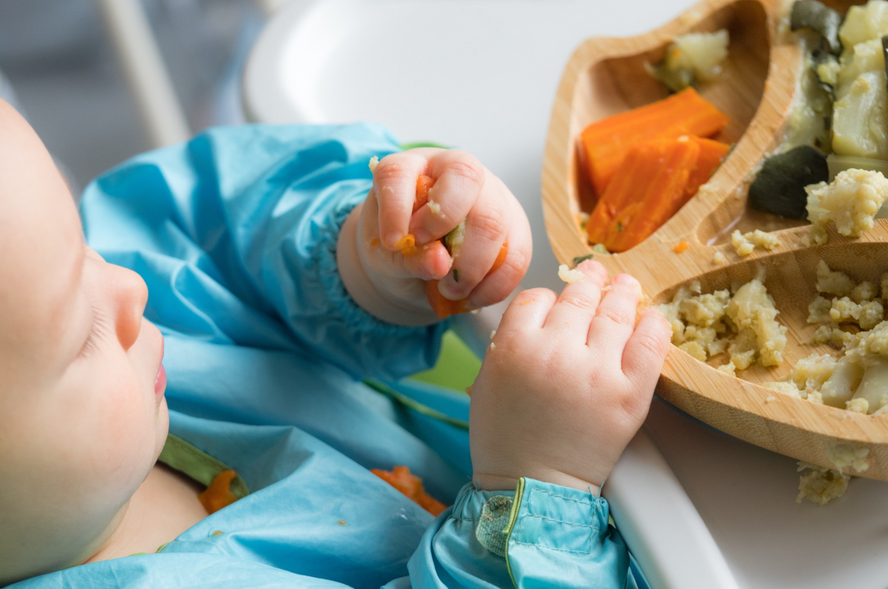
When we talk about BLW , we're actually talking about Baby-Led Weaning . In other words, it's about babies spontaneously discovering food. No purees, no spoons: with BLW, babies observe, grasp, smell, and put pieces of food in their mouths, the size and texture of which are adapted to their age and ability.
What are the advantages of DME?
Becoming a little explorer of taste is a way to experience weaning differently… And not just for your child! Among the many advantages often associated with baby-led weaning, we mention 1 2 :
- the autonomy acquired by the child
- the progress observed in terms of dexterity and autonomy
- the atmosphere at the table (since everyone can eat at the same time)
- the acceptance of new tastes facilitated by taking control of food
- awakening the sense of taste and the pleasure of eating
What are the disadvantages?
Let's be honest, baby-led weaning (BLW) is also a lesson in patience for children, as well as for those around them every day! Aside from the fact that mealtimes will tend to be longer, you'll certainly witness some Olympic-level competitions: wrestling with crushed food, throwing cookies, and plunging carrots into the water glass! In short, you might find yourself struggling at times, but if you're motivated, you'll see that the (Olympic) challenge is worth it. Finally, be aware that not all babies are keen on BLW! If this is the case with your child, don't be offended and try again in a few weeks.
At what age should I start baby-led weaning (BLW) with my baby?
To start baby-led weaning (BLW), your child must be at least 6 months old. But that's not the only criterion to consider! We'll explain everything.
Advice from experts and pediatricians
Are you thinking of trying baby-led weaning (BLW) with your baby? Before you start, make sure you check all three of these boxes:
- Your little one is at least 6 months old ✅
- He is healthy and developing normally for his age ✅
- He is able to remain seated in his high chair for the entire duration of the meal without assistance ✅
- It is capable of grasping an object, bringing it to its mouth, and releasing it. ✅
- The whole family is familiar with baby-led weaning and is ready to experience this great adventure of taste together ✅
You have 100% positive answers, so you can start baby-led weaning (BLW) soon. But if you have any doubts or questions, don't hesitate to talk to your pediatrician.
How to implement DME?
The necessary equipment
For successful baby-led weaning, we recommend having the following on hand:
- A high chair, suitable for feeding infants from 6 months old, in which your child is comfortably seated while having freedom of movement.
- a large bib or blouse (to avoid collateral damage)
- a little patience
- A high chair, suitable for feeding infants from 6 months old, in which your child is comfortably seated while having freedom of movement.
- a large bib or blouse (to avoid collateral damage)
- a little patience
And what about the spoon, you might ask? According to the pioneers of BLW, baby needs neither a spoon nor a fork since he uses… his hands!
The organization of meals
Baby-led weaning (BLW) means more autonomy and therefore more time spent at the table. As the Quebec National Institute of Public Health reminds us, babies who feed themselves generally take longer to finish their plates. If, like all parents, you sometimes find yourself in a hurry at lunch or dinner time, it's best to feed your baby with a spoon that time before calmly resuming BLW at the next meal.
Choosing the first foods
Baby-led weaning (BLW) is all about introducing solid foods. So, you'll need to follow its principles, even if your baby is in charge! From 6 months onwards, your child can try almost anything! But BLW or not, keep in mind that, initially, each food should be introduced individually. When it comes to cooking, keep it simple: boiled vegetables, steamed fruit, and no added salt or sugar! However, we encourage you to add fats to each meal (rapeseed, walnut, olive oil, and why not, a little butter now and then).
Regarding vegetables: https://www.biostime-nosmarques.com/blogs/diversification-alimentaire/quel-legume-en-premier-pour-bebe
Regarding fruit: https://www.biostime-nosmarques.com/blogs/diversification-alimentaire/quand-introduire-les-fruits-dans-lalimentation-de-bebe
Contrary to popular belief, the pieces shouldn't be too small! Even though your children have tiny fingers, they aren't as agile as we are. Ideally, offer foods long enough to extend beyond their closed fist, like our Sticks . Little by little, your baby will become more and more skillful: they'll then be just as comfortable with smaller pieces or different shapes.
At the same time, your baby will obviously continue to be breastfed on demand or to receive bottles of infant formula.
Important notice: Breast milk is the ideal and natural food for infants.
How to ensure baby's safety during baby-led weaning (BLW)?
Preventing the risk of suffocation
Baby-led weaning (BLW) is a wonderful family adventure that requires constant involvement. When a baby eats (whether it's soup with a spoon or small pieces on their own), there is a risk of choking. The food you offer should have a soft texture so your child can easily flatten it against their palate with their tongue. Avoid small, round, smooth, and sticky foods. By staying close by and offering small amounts with textures and sizes appropriate for their age, you will minimize the risks. Be aware that some babies who are feeding themselves tend to gag more often . Generally, these babies will cough and spit out the food. This reflex (called the gag reflex) helps them avoid choking.
Finally, one last safety tip: never offer recipes with two different textures. Your baby won't use the same mouth movements to chew pieces as they do to swallow purée. It's best to focus on a single texture in each dish (the moral of the story is, we'll have to wait a few more years for those "zucchini three ways" recipes à la Cyril Lignac!).
Monitoring and support
As you've probably gathered, baby-led weaning (BLW) is a team effort. Your role is to be the coach, the nutritionist, and your baby's biggest supporter. Take the time to explain the principles of BLW, offer a variety of foods while following the basics of introducing solids, encourage your baby, and make sure they swallow properly. If you're unsure about the consistency of a food, test it yourself: the right texture is when the food squishes easily between your thumb and forefinger. However, if you feel any resistance, then you'll need to adjust the cooking method.
What recipes are good for getting started with baby-led weaning?
Giving you advice is good, but making everyday life even sweeter with special baby-led weaning recipes is even better… Right?
Easy recipes for baby-led weaning
At Good Goût, we wake up every morning wanting to simplify parents' lives. So, when it comes to baby-led weaning (BLW), we've created a variety of fun and delicious cookie and food recipes perfect for your curious babies. Shapes, textures, flavors, nutritional value: they've all been designed to make BLW a breeze.
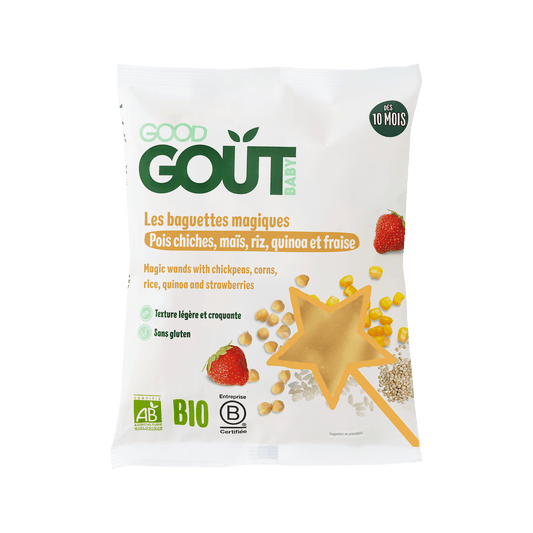
Easy to grasp and nibble from 10 months onwards, these Round Biscuits are both fun and delicious. With them, baby-led weaning (BLW) can also be incorporated into snack time.
Designed to make aperitifs absolutely irresistible, these Amuse-Bouches can be given to babies from 12 months old.
Specially designed to delight the taste buds and promote fine motor skills from 12 months.
Our tips for varying textures and flavors
Babies are just like us: when it comes to discovering new flavors, their curiosity knows no bounds. To avoid falling into a routine with baby-led weaning (BLW), we suggest alternating your meals with raw ingredients (like ripe bananas, pears, or peaches that are always well-washed beforehand) and cooked ingredients (vegetables, meats, fish, and harder fruits). As for grains or legumes, they can be incorporated into delicious recipes, from pancakes to muffins, which you can, of course, also make savory!
How to manage common challenges in DME?
As with any adventure, there's an element of mystery and unexpected situations. Baby-led weaning is no exception. Food rejection, refusal, allergies… Let us shed some light on the subject!
Food rejections and refusals
Developing a baby's palate isn't always smooth sailing! Some children refuse to try or spit out food they don't like. Don't worry, they're just like us: their tastes evolve over time, and their preferences change. If your baby is resisting, simply try again a few days later! You might be surprised to see if they take it differently (or not!).
In any case, vary the foods as much as possible to turn him into a true culinary adventurer! And if your child doesn't want to eat at all, don't force him. He may simply be full, tired, or confused by the new food you've just introduced. The next meal will certainly be very different!
Allergies
As with traditional weaning, it's important to introduce allergens gradually. Potential allergens include eggs, fish, shellfish, nuts (almonds, hazelnuts, etc.), celery, milk, lupin (a legume), sesame, and certain mollusks. Don't forget gluten, peanuts, and sulfites. From the start of baby-led weaning (BLW), and at the appropriate time depending on your child's age, you can offer foods from these groups. Ideally, allergens should be introduced before your baby is 12 months old, offering only one allergen at a time for three consecutive days.
If you notice or suspect an allergic reaction (vomiting, diarrhea, red patches, hives, eczema, asthma, swollen throat or lips, difficulty breathing…) consult your pediatrician or call 15 in case of emergency.
"Parents' Testimonials": They practiced BLW, and they share their experiences!
Breastfeeding and baby-led weaning, discovering new flavors, gagging: find parents' stories on the La Leche League website.
- https://www.caf.fr/allocataires/vies-de-famille/articles/qu-est-ce-que-la-dme-la-diversification-menee-par-l-enfant-et-comment-la-mettre-en-pratique-au
- https://www.mangerbouger.fr/manger-mieux/a-tout-age-et-a-chaque-etape-de-la-vie/jeunes-enfants-de-0-a-3-ans-du-lait-a-la-diversification/a-partir-de-6-8-mois-on-touche-on-mache-on-decouvre-de-nouvelles-textures
- https://www.mangerbouger.fr/content/show/1500/file/Brochure-SPF-Mangerbougerfr.pdf
- https://www.inspq.qc.ca/mieux-vivre/alimentation/aliments/diversification-alimentaire-menee-par-enfant
- https://www.inspq.qc.ca/mieux-vivre/alimentation/aliments/diversification-alimentaire-menee-par-enfant