Diversification of food: DME or classic method?

In the category of "parental existential questions , " I present... weaning ! Stay with us, we'll help you see things more clearly between baby-led weaning (BLW) and solid foods! (Child-Led Weaning) and traditional method .
How can you be sure you're making the right choice between baby-led weaning (BLW) and traditional weaning?
For a long time, the rule was relatively simple: you followed the pediatrician's recommendations and off you went! On one side, you had the baby with their mouth wide open in their high chair, and on the other, parents, highly motivated to try some turnip puree or pear compote . It didn't always work, but that's how it was! And then, Baby-Led Weaning (BLW) arrived…
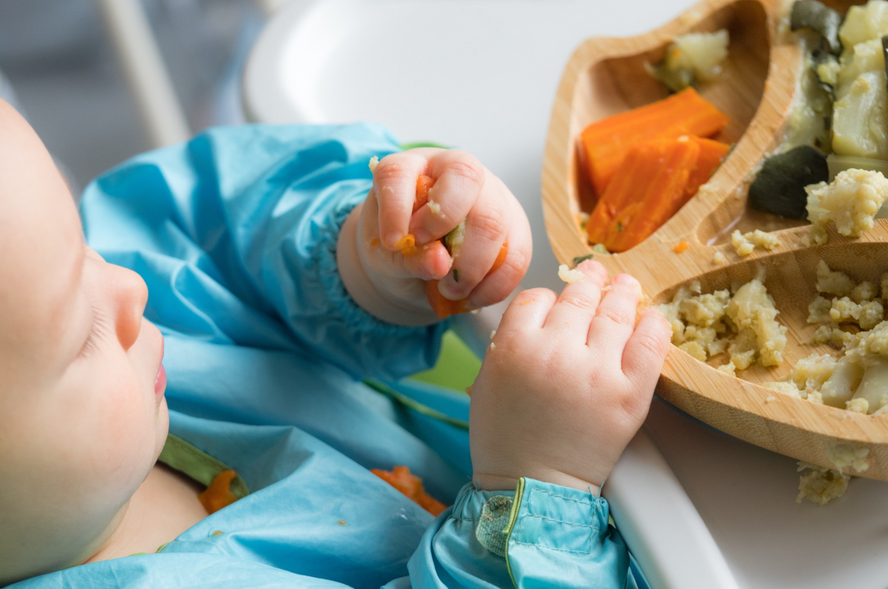
…And the roles were almost reversed! Parents no longer had a monopoly on the spoon, and baby had free rein to touch, smell, grab, and nibble on pieces of food.¹ Rest assured, the picture is not all black and white: both methods have advantages and disadvantages .
What are the advantages and disadvantages of each method?
The main advantage of traditional weaning is the control over quantities : in other words, you're the metronome when it comes to purées and compotes ! Since you're the conductor with a spoon as your baton, it's easy to imagine that the so -called classic method generates less waste . For some anxious parents who have a phobia of choking, the traditional method also has the merit of being less stressful .
In terms of DME (Digital Mother-of-Bethlehem), the strong point is obviously the autonomy. of the child. Because yes, it's really the baby who's in charge! By taking the lead, they develop their fine motor skills and explore smells, tastes, textures, and colors in their own way and at their own pace. For some, baby-led weaning (BLW) is a way to simplify daily life with the same menu for the whole family… however, be careful not to confuse autonomy with eating lunch or dinner alone: BLW should be considered a guided exploration of food .
What precautions should be taken before starting?
Before choosing one method over another, it's important to ask yourself the right questions! Is your baby ready? Am I ready? Is my partner ready? It's important to see introducing solid foods as a team effort , not a duel with your child. If everyone is on board, it will definitely be easier! For younger children, first take an objective look at the situation : your child is 6 months or older , must be healthy and developing normally for their age , can sit unsupported in a high chair and remain seated for about fifteen minutes, and can grasp objects and puts them in the mouth without letting go. Without one of these essential conditions, baby-led weaning is not recommended.
Before you start, always ask your pediatrician for advice… he is also part of your team!
What foods are recommended for each method ?
In terms of menus, the rules are the same whether you choose traditional weaning or baby-led weaning (BLW). The first thing to keep in mind: always introduce foods one at a time , so as not to confuse them. So forget paella or cassoulet to start. At the beginning, the consistency is also extremely important: you must be able to crush the pieces between your thumb and forefinger without forcing it. If you opt for baby-led weaning (BLW), the size of the pieces This will also be important since the baby needs to be able to grasp them independently. From now on, it's considered that there's no particular order to follow . Vegetables, fruits, poultry, fish, red meat, eggs, legumes, starchy foods, dairy products: you can choose from all food groups. However, honey should be avoided (until the child is 1 year old), as well as sugar and salt (until they are 3 years old).
Can the two methods be combined?
The answer is yes! There's nothing stopping you from combining both methods and being flexible . For example, you can start weaning in the traditional way with pureed foods and then switch to baby-led weaning (BLW) by later offering whole foods to your little one. You can also use several spoons: one for your child and one for you. This way, they'll become familiar with the spoon , develop their motor skills , and you can still intervene. and keep an eye on the quantities consumed.
The word about hunger !
There is no right or wrong way. Whether you choose traditional weaning, baby-led weaning (BLW), or a combination of both, what matters is that you are comfortable with your choices. Keep in mind that the goal of introducing solid foods is to awaken your child 's senses , develop their palate , and above all, inspire them to be a culinary adventurer. !
1 https://www.caf.fr/allocataires/vies-de-famille/articles/qu-est-ce-que-la-dme-la-diversification-menee-par-l-enfant-et-comment-la-mettre-en-pratique-au
2 https://www.mangerbouger.fr/content/show/1500/file/Brochure-SPF-Mangerbougerfr.pdf
3 https://www.inspq.qc.ca/mieux-vivre/alimentation/aliments/diversification-alimentaire-menee-par-enfant
4 https://www.mangerbouger.fr/content/show/1500/file/Brochure-SPF-Mangerbougerfr.pdf
5 “Broccoli, sardines and spaghetti: baby-led weaning becomes flexible and accessible”, Manon Brzostek, Eyrolles editions