How about giving your breastfeeding a little boost? Breastfeeding teas allow you to stimulate lactation in a 100% natural way and benefit your baby at the same time. Enough talk, let's tell you more about this ally for mothers!
What is breastfeeding tea?
Breastfeeding tea is made from plants called "galactagogues," meaning they promote milk production. This tea can be helpful, for example, when:
- The mother is very tired or stressed, which can slow down milk production.
- Babies have growth spurts: they want to nurse more frequently. Around 3 weeks, 6 weeks, 3 and 6 months, it's a race to the breast!
- The mother (re)takes hormonal contraceptives, which can sometimes decrease milk production.
It's worth noting that after a certain period following childbirth, prolactin levels (yes, you know, that famous hormone that triggers lactation!) drop, and unless the mother is stimulated regularly and effectively, milk production decreases. Let's be honest, it's not always easy to be stimulated all day long, especially when returning to work and other activities that reduce breastfeeding. Hence the usefulness of breastfeeding tea, to give new mothers a little boost!
It kills two birds with one stone, it also allows your baby to be well hydrated and that's absolutely essential!
Good to know
There are two types of breastfeeding teas: the first are used to boost your lactation, while the second relieve colic in your little one.
What's in breastfeeding tea?
Most breastfeeding teas contain[1]:
- Fenugreek: beyond its stimulating effect on breast milk, it is said to have some postpartum health benefits, such as maintaining normal blood glucose levels and regulating fat metabolism[2]. How wonderful!
- Nettle: it stimulates milk production and enriches its composition. Its added bonus? It gives mothers a lovely energy boost thanks to its invigorating properties. We say yes!
- Verbena: its calming effect reduces your fatigue and stress, sometimes responsible for a lack of milk.
- Cumin: it stimulates milk production while soothing minor digestive issues (and we're grateful for that). Don't hesitate to add it to your dishes in addition to your herbal teas! You'll see, it's delicious…
And many others like shatavari, green anise, or galega!
A tip: choose organic ones to avoid GMOs (Genetically Modified Organisms), not ideal for your little one.
What is the recommended dose for my breastfeeding herbal tea?
Three cups of herbal tea a day are recommended to see positive effects on your milk supply[3]. We know what you're thinking: no, milk production doesn't necessarily increase overnight! For some mothers, it does, and for others, it will take a few days. Patience is key…
Our little tip
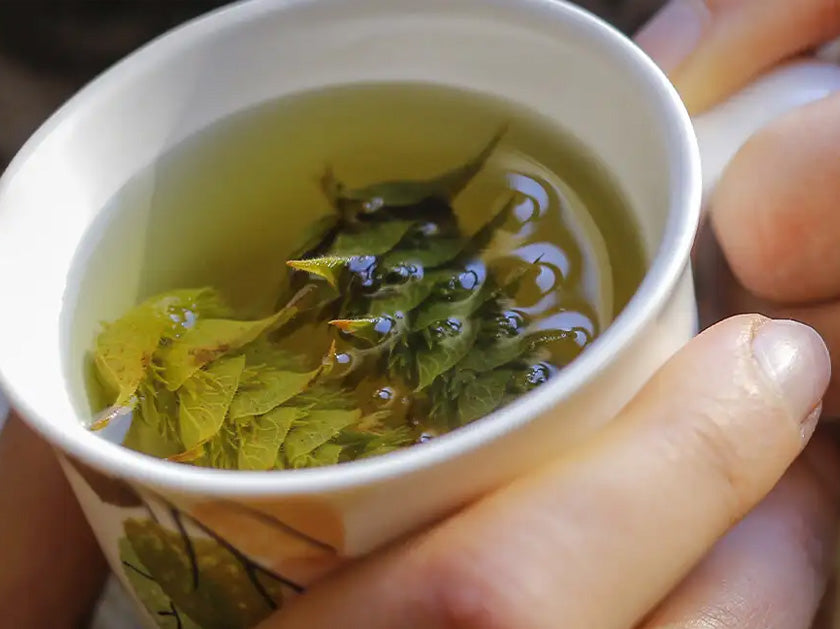
Cover your herbal tea with a lid while it steeps to fully activate its active ingredients. This prevents them from evaporating!
Making your own breastfeeding tea: yes, but with caution
Do you prefer a DIY (Do It Yourself) herbal tea? Why not, but provided you respect certain conditions.
- Avoid certain plants like sage, peppermint, or parsley, which can, conversely, lower your milk production[4]. On the other hand, they can be effective if you want to reduce your lactation (we'll keep that in mind!).
- For fenugreek teas, be careful not to exceed ¼ teaspoon of seeds, steeped for 10 minutes in 225 ml of water 3 times a day[5]. This plant contains steroids which, beyond this dose, can be harmful to your little one.
If in doubt, please consult a healthcare professional.
Be aware that certain foods also promote lactation, such as oats (their iron content stimulates milk production), fennel[6] (which boosts our prolactin production), and water! Yes, 87% of breast milk is water[7]. Aim for at least 2 liters per day while breastfeeding.
Psst, tell us your breastfeeding tips: we would love to have your advice!
Tell us about your experience!
Have you ever tried breastfeeding teas? If so, did they boost your milk supply? Would you like to learn more about these natural remedies? Share your experiences and ask us your questions at contact@biostime.fr or via DM on Instagram @biostime.fr . See you soon!
Important notice: Breast milk is the ideal and natural food for infants.
[1] Source: “Breastfeeding Tea to Stimulate Milk Production” jollymama.fr, January 9, 2019 https://jollymama.fr/guide/la-tisane-dallaitement-pour-stimuler-la-production-de-lait/
[2] Source: “Breastfeeding Tea to Stimulate Milk Production”, jollymama, September 1, 2019 https://jollymama.fr/guide/la-tisane-dallaitement-pour-stimuler-la-production-de-lait/
[3] Source: “Breastfeeding tea: is it really effective?”, magicmaman, January 11, 2021 https://www.magicmaman.com/tisane-allaitement-est-ce-vraiment-efficace,3666962.asp
[4] Source: “Feeding during breastfeeding,” Naître et grandir, December 2017 https://naitreetgrandir.com/fr/etape/0_12_mois/alimentation/fiche.aspx?doc=naitre-grandir-alimentation-pendant-allaitement
[5] Source: Breastfeeding Files number 66, La Leche League, January-February-March 2006 https://www.lllfrance.org/vous-informer/fonds-documentaire/dossiers-de-l-allaitement/1488-da-66-les-galactologues
[6] Source: “What are the 15 foods that promote lactation?” neufmois.fr, March 26, 2021 https://www.neufmois.fr/mon-bebe/allaitement/quels-sont-les-15-aliments-favorisant-la-lactation%E2%80%89
[7] Source: “What to eat and drink when breastfeeding?” Santé Magazine, May 26, 2021 https://www.santemagazine.fr/bebe/alimentation-du-bebe/que-manger-et-que-boire-quand-on-allaite-175706