What is baby bottle syndrome?

The teething period is a distant memory, and your child now has beautiful baby teeth. It's important to take good care of them to avoid problems like baby bottle tooth decay. If this name doesn't ring a bell, that's perfectly normal! Often misunderstood by new parents, this syndrome, also called baby bottle tooth decay, is characterized by the early appearance of cavities in the baby teeth of young children. What are the causes? How can you recognize it? How can you treat it, and above all, how can you prevent it? At Biostime , we explain everything you need to know about baby bottle tooth decay!
Baby bottle syndrome: what is it?
Baby bottle tooth decay is characterized by the early development of multiple cavities in baby teeth. It typically occurs around the age of 3 or 4, but can also affect much younger children. Because the enamel of baby teeth is much thinner than that of permanent teeth, they are more vulnerable to cavities. Baby bottle tooth decay can cause pain, infections, damage to developing permanent teeth, and difficulty chewing. Therefore, it is crucial to prevent it or, if it does occur, treat it as early as possible.
What are the causes of baby bottle syndrome?
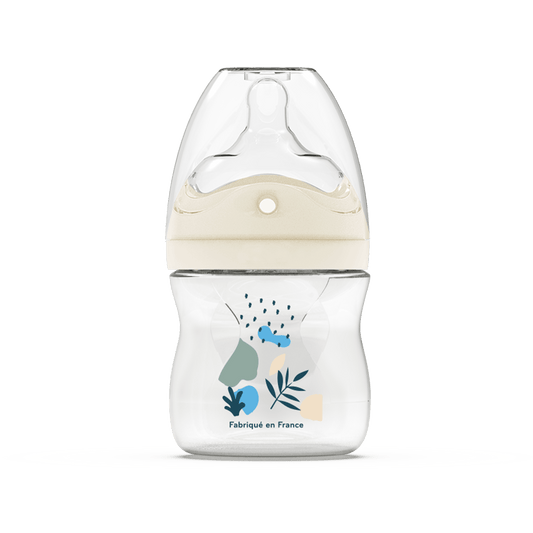
We often hear that milk is responsible for baby bottle tooth decay, which sometimes worries parents. Rest assured, it's not the culprit! The problem lies in leaving a bottle of sugary liquid (fruit juice, sweetened water, milk, etc.) available to your child throughout the day. Why? Because teeth are constantly bathed in a sugary environment, which allows the bacteria that cause cavities to develop and multiply rapidly!
Children most affected by this syndrome are those who have a sugary bottle just before going to sleep. The reason? The amount of saliva, which plays a protective role against cavities(1), decreases during sleep, and teeth are less protected against the acid attacks of sugar.
How to identify baby bottle syndrome?
In its early stages, only a dentist's expert eye can detect baby bottle tooth decay. If the condition has already progressed, several signs can give you a clue:
- Stains appear on the teeth. It is usually the upper teeth that are affected first, between the canines;
- The color of the teeth changes to become brownish;
- Demineralization of enamel makes teeth more fragile: they can break more easily;
- The child expresses pain when eating.
How to treat baby bottle syndrome?
Dental care is essential. Treatment will involve dental care to stop the progression of cavities, as well as long-term treatment and the implementation of hygiene and dietary measures.
How to prevent baby bottle syndrome?
The good news is that it is possible to prevent this baby bottle syndrome, simply by adopting a few good habits.
- Get your child used to drinking water rather than sugary drinks, the consumption of which is not recommended;
- Do not give a bottle of milk, fruit juice or sweetened water just before bedtime or naptime;
- Brush baby teeth, with a suitable brush and special children's toothpaste, twice a day³. This is the best way to establish a routine and good dental hygiene;
- Having regular dental checkups from the appearance of the first tooth, in order to detect any problems as early as possible and to get your child used to the dentist.
Share your stories!
Are you familiar with baby bottle tooth decay? Has your dentist ever mentioned it? Share your experiences or questions on our Instagram @biostimefr or at contact@biostime.fr . We look forward to hearing from you!
- Tungare S, Paranjpe AG. Early Childhood Caries. In: StatPearls. StatPearls Publishing, Treasure Island (FL); 2021. PMID: 30570970.
- Marie Theillaud. Early childhood caries: the perspective of midwives, pediatric nurses, and childcare assistants in the Aquitaine-Poitou-Charentes-Limousin region. Surgery. 2016. ffdumas-01285427f
- Madrid C, Abarca M et al. Baby bottle caries: a thorn in the side of health. Rev Med Suisse 2012; 8:764-768
- Hallot I. Early Childhood Professionals: All you need to know about baby bottle tooth decay or early childhood caries. 2020. https://lesprosdelapetiteenfance.fr/bebes-enfants/sante-prevention/fiche-maladies-et-petits-maux/tout-savoir-sur-le-syndrome-du-biberon-ou-carie-precoce-de-lenfant
- UFSBD. [Online] Babies - Children. [Accessed 26/04/2022] Available: https://www.ufsbd.fr/espace-grand-public/votre-sante-bucco-dentaire/bebes-enfants/#:~:text=L'UFSBD%20recommande%20ainsi%20aux,anniversaire%20puis%20r%C3%A9guli%C3%A8rement%20chaque%20ann%C3%A9e.&text=Les%20dents%20de%20lait%20de,l%C3%A2ge%20de%206%20mois
- Alazmah AJ Contemp Dent Pract 2017;18(8):732-737.
(1)MOUTON C, ROBERT JC (1994b). Oral and dental bacteriology. Masson ed. Paris.